

Anjaneyasana
'A treasure to be discovered'

Anjaneyasana: the Monkey Lunge pose. Luke Ketterhagen, in an article for Yoga International, describe this pose as a “treasure waiting to be discovered.” Ana Forrest also recommends practising lunge pose in her book Fierce Medicine. “When you are moving into Lunge, you’re dealing with big muscles –quadriceps- so it takes a while for the pose to take its effect. This pose is so simple, and it works deeply. Anatomically, it’s straightforward, but energetically and physiologically, it’s a mover and a shaker.” So let’s look a bit closer at this pose.
Origin of the name
Looking at the origin of a pose’s name can be really useful as it indicates what we should focus on. Anjaneyasana means the son of Anjana. Let me tell you a little story about deities.
Once upon a time, there was a little girl called Anjanaplaying on the Earth. She thought she saw a monkey sitting in the lotus position and threw fruit at him. Unfortunately, it wasn’t a monkey but a powerful sage who had taken the shape of a monkey to do his meditation in peace. He was very upset and cursed the poor child. She would become a monkey as soon as she fell in love. Poor Anjana went back to her Paradise sad and afraid.
Thank Brahma, Anjana found a kind of solution. She would go back to Earth, fell in love with an earthly husband and give birth to a divine son who would be the incarnation of Lord Shiva himself, and the curse would be removed. She did exactly that and gave birth to a son called Anjaneyasana.
There are various versions of the story. My favourite is that Anjaneysana was a little cheeky one and wanted to get a piece of the Sun. So he took a big step, bent his front leg and reached for the Sun with his arms. (Image from dedechter.com)
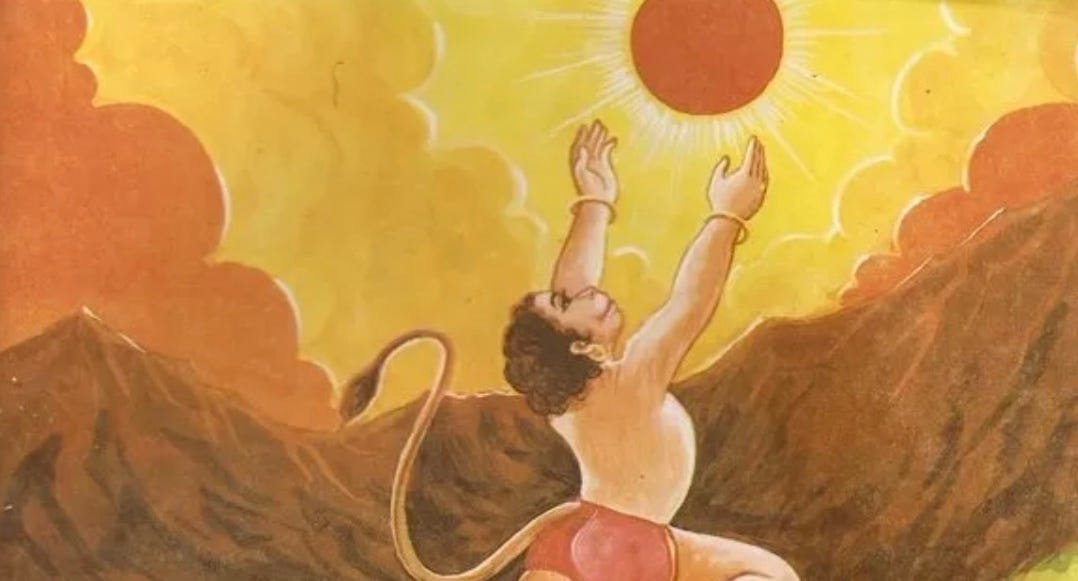
He then got into a lot of troubles as the Sun got furious… and Anjaneya was later renamed Hanuman, the Monkey God. But that is for another blog post.
Getting into the pose
You can start from downward-facing dog or more easily from Table Top, ie on all four. Step your left foot forward between your hands. Left knee is directly over the ankle and the shin perpendicular to the ground. Extend the right leg behind and place the knee on the floor.
Then lengthen the left thigh forward and the right thigh back, lowering the hips towards the mat, keeping the hips square to the front of the mat. Raise the arms towards the ceiling, reaching for the Sun. Stay in the pose for a few breaths and then come back to table position or downward-dog and change side.
To be honest, it wasn’t one of my favourite postures when I started yoga. My thighs were burning but you can work on it progressively.
Using a chair
Even if you can do the pose without a chair, it’s actually really nice to practise with a chair because you can focus on stretching the hip flexors of the back leg slowly first without the weight of the body opening up the hips too quickly.
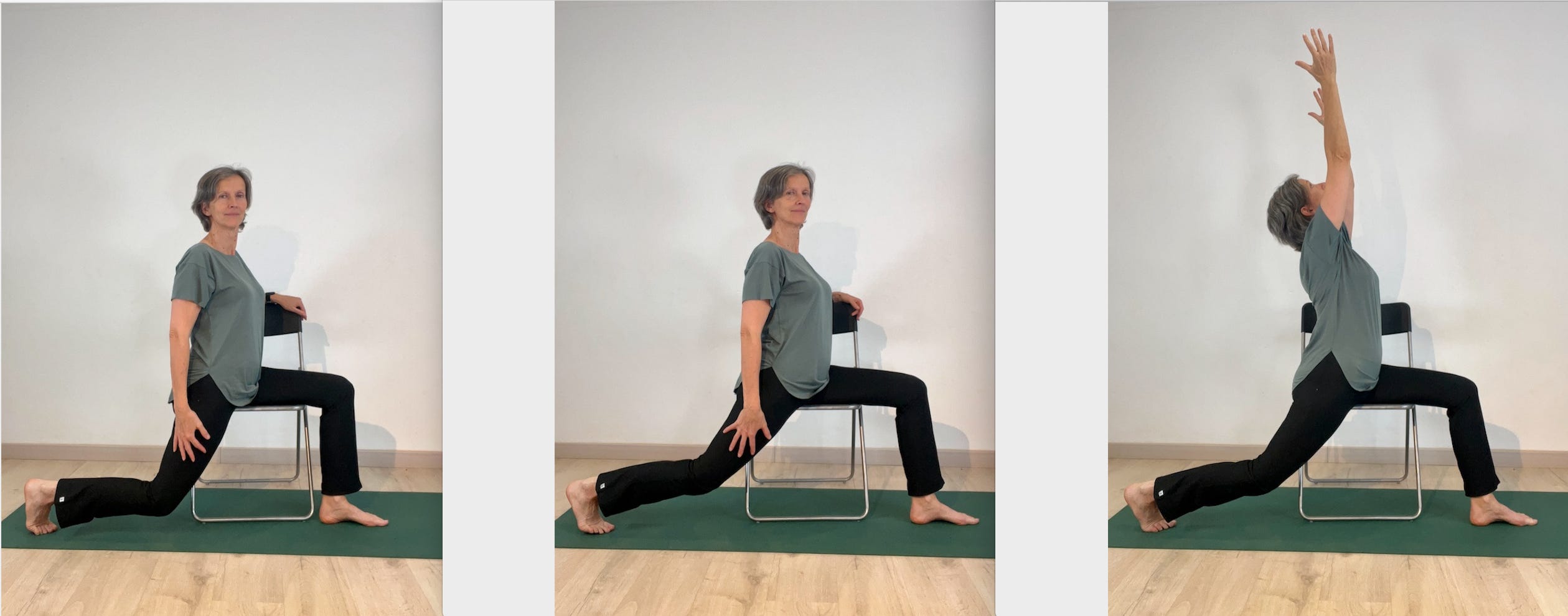
Sitting sideways on the chair, you can slowly extend the back leg while holding the back of the chair for stability. Once you feel stable enough, then you can raise the arms overhead.
Using bricks
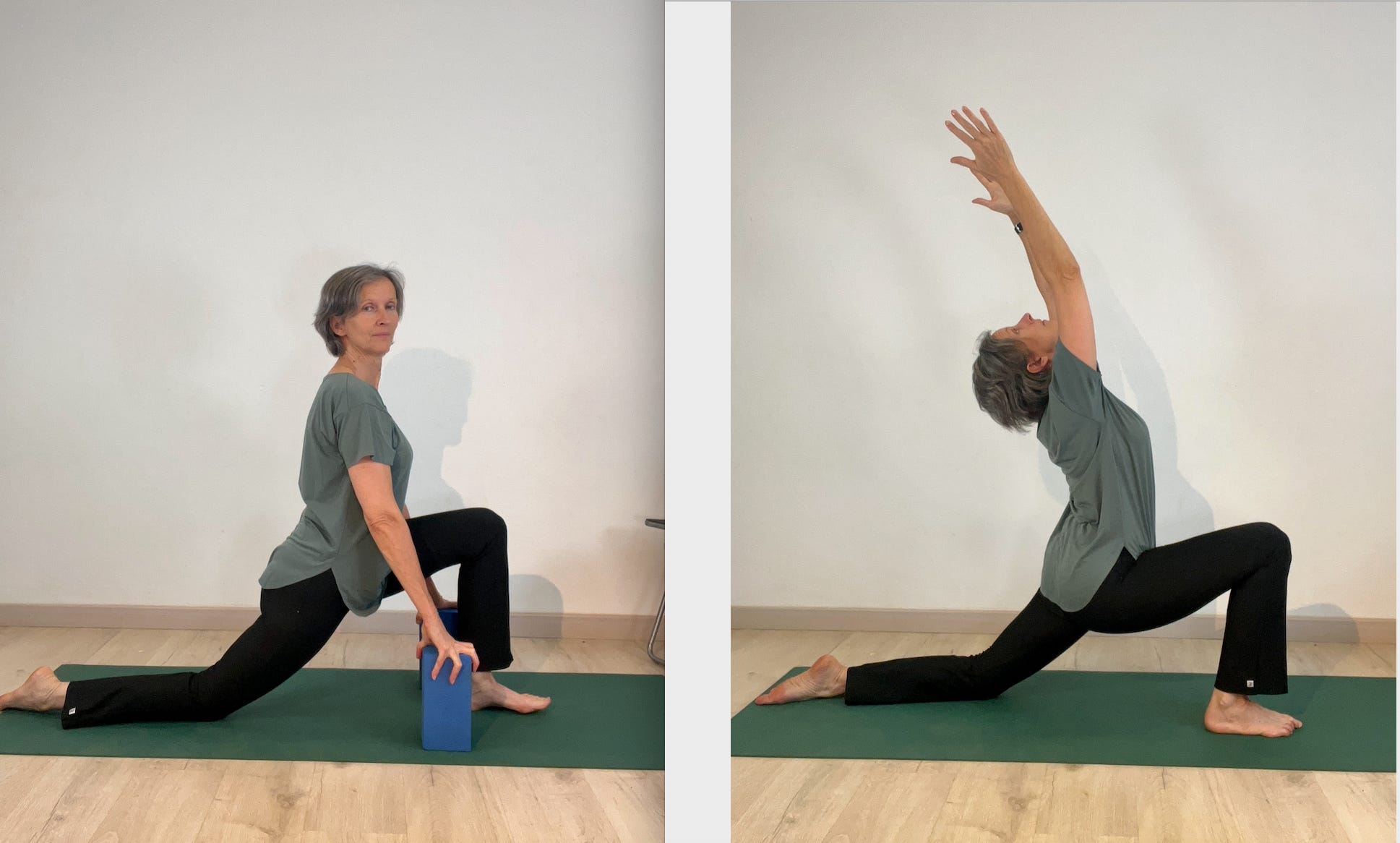
Another way to slowly get into the pose is to use bricks to support your hands so you can ‘control’ how deep you get into the pose before you get into the full Anjaneyasana.
There are also minor adjustments that make it more comfy, like for instance placing something under the kneecap if it is uncomfortable. I also like to lift the toes and press the ball of the foot (of the front leg) to make sure my knee doesn’t rotate inwards and stays in line with the ankle and the hip.
Letting go
This is the crucial part in this pose. The more relaxed you are, the more your muscles will release. Gently! As Ana Forrest said, you need time in this pose to really experience it. For some people, doing lunges releases a lot of emotions. If you feel “vulnerable”, just return to your breath to relax. Let go at all levels, and observe what happens without judging yourself.
I now really enjoy the lunges and I increasingly practise the Yin version (called the Dragon Pose) with the hands down, holding the pose for 2 minutes. It stimulates the stomach and spleen meridians (on the extended leg) and the kidney and liver meridians on the bent leg.
The benefits
Anjaneysana has a lot of benefits both on the physical and energetic levels.
Releases the hip flexors (which often get tight whether due to MS or to sitting too many hours a day).
Strengthens the quadriceps and gluteus muscles.
Expands the chest, lungs, and shoulders.
Develops endurance in the legs.
Improves balance, focus, and core awareness.
Calms the mind.
So why not try to reach for the Sun and see what moves…
Have a wonderful week.
See you on the mat.
Excellent explanation...I've doing a variation of this pose for years - now I know how to properly practice it - I think it's the perfect pose to learn for writers...