

Relax your Body, Switch off your Brain
An alternative to slouching on the couch with a glass of wine

Imagine you’ve had a tough day and you’re really tired. You come into the living room. The couch is there, so soft and attractive… It’s calling you: come to me, come to me! Maybe even with a glass of wine. Does it sound familiar?
Next time it happens, if you really want to relax your body and mind, resist the call of the couch! No worry, I’m not going to argue for a ban on couches… In June, in another post, I focused on the benefits of resting, explaining why real rest is key for healing, and mentioned the practice of Yoga Nidra or Non Sleep Deep Relaxation (NSDR).
Today, I’d like to share more ideas to switch off your body and mind that I learned in a Teacher Training with Roger Cole, PhD, yoga teacher and scientist, specialist of relaxation, sleep, and circadian rhythms.
Restorative Yoga
Roger Cole gave a great definition of Restorative Yoga: it’s about finding a position that is so comfortable that you do not want to move ever again! I love this definition.
In a restorative yoga class, we use a lot of props to support the body and encourage it to release tensions. Poses are usually held for 5 to 10 minutes and we focus on the breath to activate the parasympathetic nervous system (PNS) - or in other words to trigger the ‘rest & digest’ response. After a while, the breath slows down, the blood pressure decreases and …. your stomach starts to rumble as digestion improves ;-)
Does lying on the belly or the back, fully supported by lots of pillows or bolsters sound good? It surely does for me. But we can use another clever mechanism in our body to relax even more, unless you suffer from high blood pressure, in which case it is not recommended.
Baroreflex & Inversions
As usual, our body seeks balance and avoids any disruption. We have receptors in blood vessels near the heart - and some in the neck- called baroreceptors. Their job is to send the brain information about blood volume and pressure so the brain can give the right command to the heart in order to regulate blood flow. This is called the baroreflex.
What's less known among scientists - except for a handful of sleep research scientists- is that the same reflex that slows down your heart and tells it to relax has a parallel branch that slows down your brain, and tells it to relax when the pressure increases in your neck. Roger Cole
What happens when we lie down flat on the map? The head and heart are at about the same level. Baroreceptors tell our brain and nervous system that it’s time to lower blood pressure and relax. Let’s now compare what happens when we move into an inversion, that is when the head is lower than the heart. More blood goes to the head, right? Baroreceptors send a stronger signal to the brain, something like ‘Too much blood coming to you! Careful! So the brain pulls on the brake even more, the heart slows down AND the brain relaxes too.
This is why in yoga we have so many inversions (downward dog, headstand etc…) but when we’re really tired, do we really want to get into a headstand for 10 minutes?
Neck Flexion
Good news. There is another way we can increase the signal sent to the brain without moving into a full inversion. Simply by drawing the chin to the chest. Why? Because some of the baroreceptors are in the neck. So when we flex the neck, we increase the pressure on these baroreceptors. This gives us a few options to trigger a relaxation response. We could:
Sit and flex the neck instead of lying down
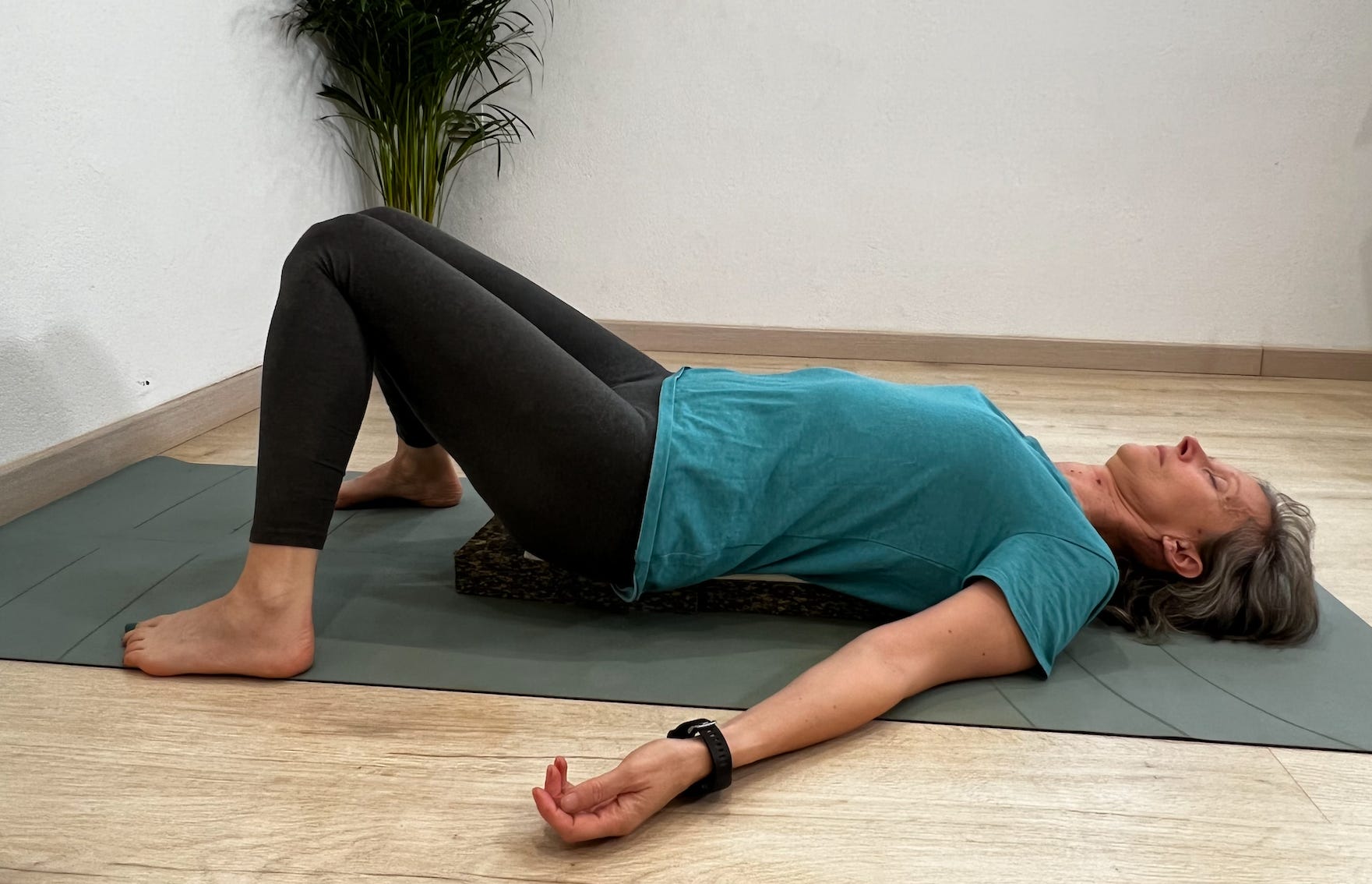
Lie down, with the chin slightly tucked in
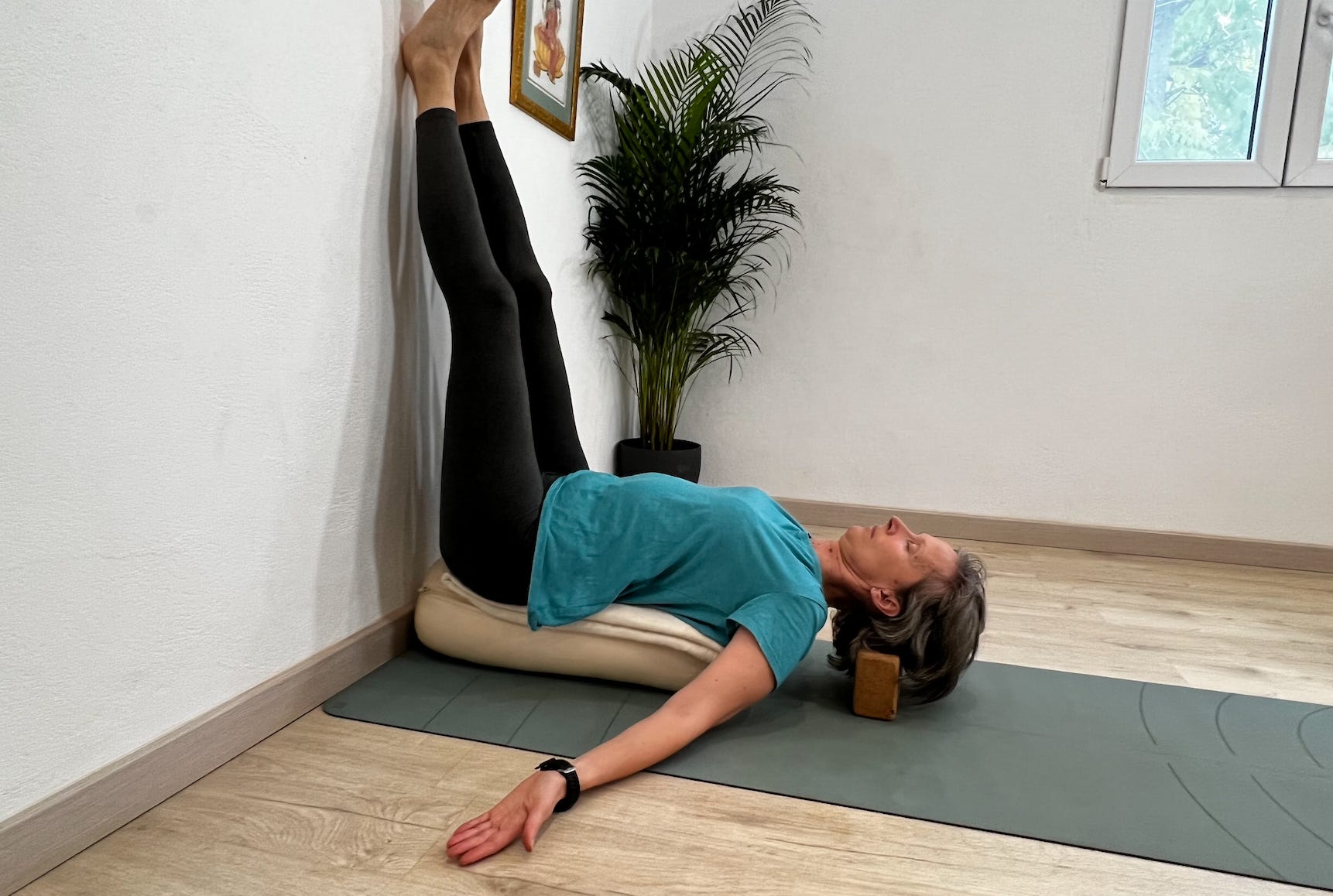
Or lie down in a mild inversion, with the head lower than the heart AND tuck the chin in for a super-duper relaxation.
As you can imagine, the third option brings stronger results and it is also the most comfortable. Would you like to give it a try? Here are some ideas to play around with. Please please be safe and if you’re unsure, send me message and I’ll be more than happy to answer.
Legs up the wall, on a bolster and with a brick under the head
On folded blankets, chin tucked in
By the way, you can still get this glass of wine afterwards …
See you on the mat
Véronique
Fascinating explanations. How long would you recommend staying in one of the positions?