

Making yoga accessible
Adapting yoga to your needs

I started yoga in 2000 without knowing anything about the different yoga schools. I went to the classes that suited my timetable best, and joined an Ashtanga and an Iyengar class per week. I feel in love with Ashtanga. It was challenging and dynamic. The Iyengar class was quite challenging too but in a different way.
In fact, both Ashtanga and Iyengar are quite rigorous and demanding. At the time, I embraced yoga as a challenge and wanted to ‘do the pose’ exactly as described. But over time I realised it shouldn’t be the priority.
Your body is unique
I’d like to share an example given by Bernie Clark in his book Your Body, Your Yoga. It is usually consider that the thigh bone (femur) neck-shaft angle is 126º but here is an illustration of ‘real’ femur. As you can see, the angle varies a lot. (Both illustrations are from Your Body, Your Yoga)
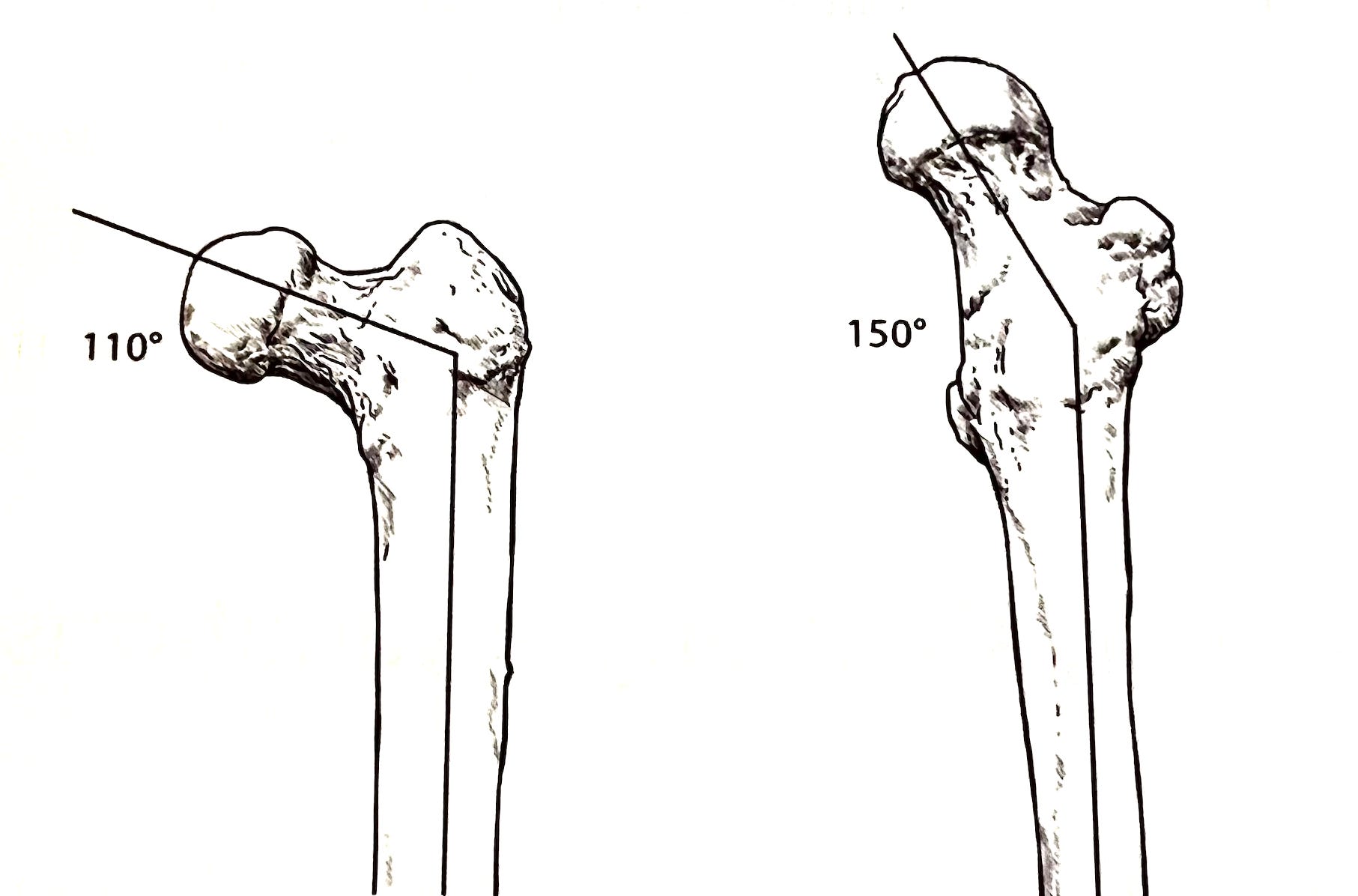
In fact, the average angle varies a lot across cultures as well as across genders. This matters a lot. Based on the shape of your femur, your Triangle pose will look different.
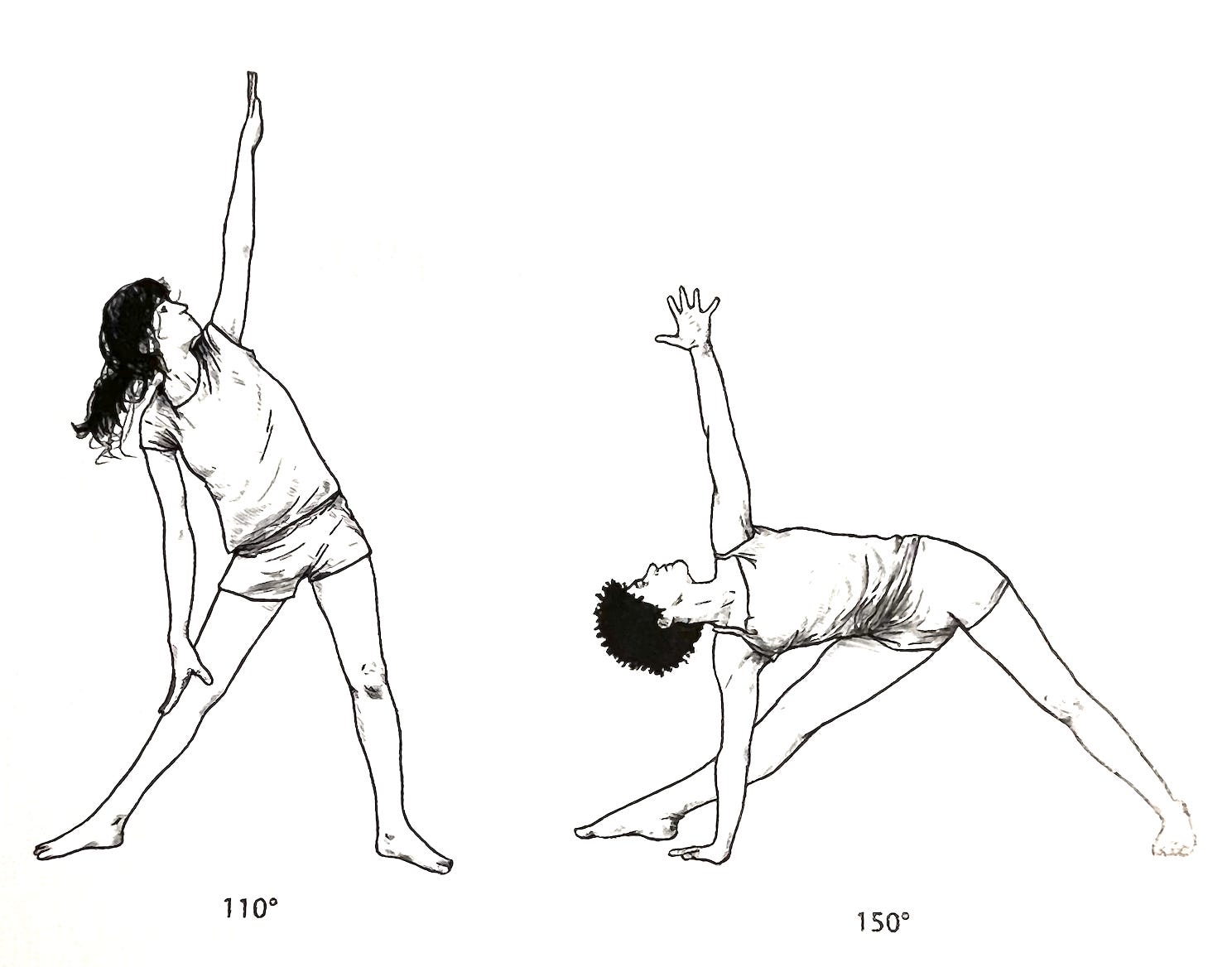
So unless they change the head of their femur, the above two students will not do the same Triangle.
Adapt the pose, not the person
This is the message that Jivana Heyman, founder of Accessible Yoga, keeps repeating enthusiastically. There are many ways to make a pose more accessible.
We can use props. I love using blocks, cushions, towels, blankets, belts, straps… You can use them to ‘lengthen’ the arms or raise the floor. You can use them to make connection and feel supported, to allow you to find ease in the pose, which is the definition of an asana!
Find the essence of the pose and focus on it. For instance, in the Downward Dog pose, the essence of the pose is the lengthening of the spine. Whether you have the hands on the wall, on a chair or on the floor, you can lengthen the spine and feel the Downward Facing Dog pose.
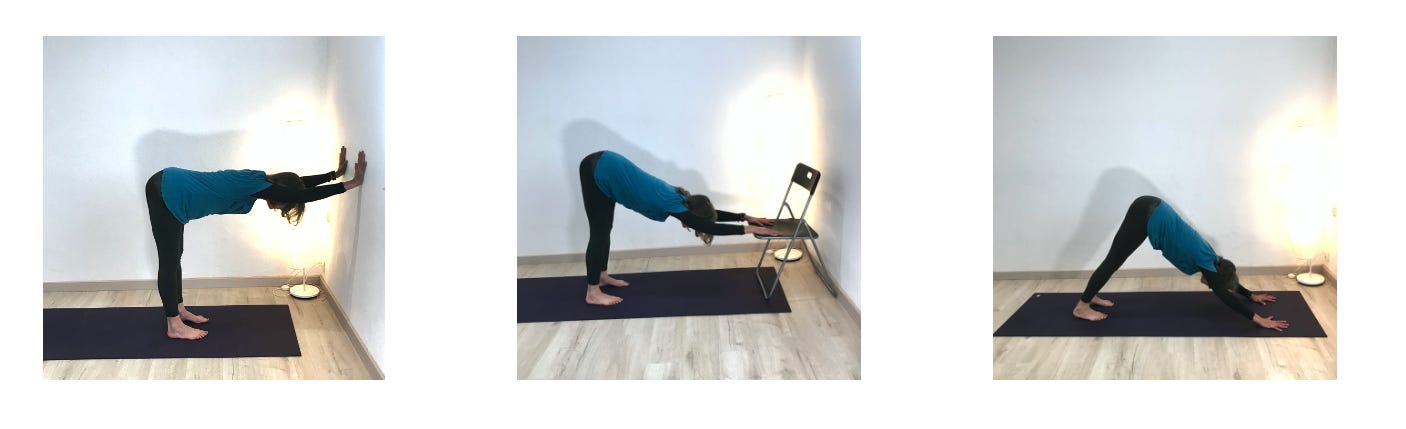
The key is to remember that:
"People are more important than poses, and it's better to adapt a pose to a person than a person to a pose."
—Jivana Heyman
Find ease in the pose
According to the sage Patanjali, author of the classical yoga text called the Yoga Sutras, an "asana" is a position that “is steady and comfortable". I know, I know… it’s easier said than done and sometimes, a pose just doesn’t feel comfortable. What should you do then?
First, if you experience ‘discomfort’, then ask yourself why. Most of the time, the discomfort is due to our muscles getting stretched. Another potential cause could be that we’re ‘anxious’ and create tension. In both cases, I find it useful to use the breath. If you lengthen the exhale (inhale for 4 seconds, exhale for 6 for instance), then the body and the mind relax. You can ease into the pose.
Second, if you experience pain, then come out of the pose. Yoga shouldn’t be painful. It might be that an old injury is waking up. I’d suggest talking to your teacher and finding ways to adapt the pose or use an alternative pose altogether. This is of course easier if you attend a low pace class.
Enjoy it!
Even if, like me, you consider yoga as a medicine, it should be enjoyable. If it isn’t, what could you do to make it more pleasant? Join a different class? Ask a buddy to join you? Take your mat outside? Play your favorite background music?
But above all, allow yourself to be fully present. Yoga is a beautiful journey that requires your full attention. Sense, feel, explore… your breath, your sensations. This is such a great opportunity for self-discovery.
I wish you a wonderful practice.
See you on the mat