

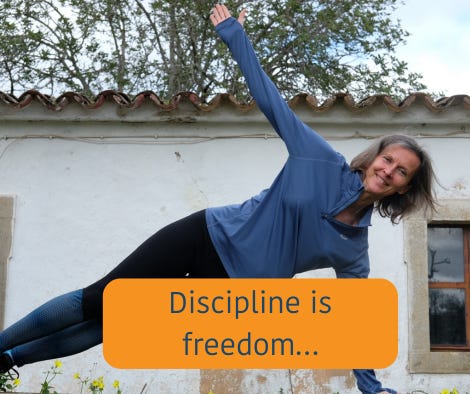
Discipline is Freedom
Two arguments in favour of sticking to your practice, whether it is yoga, breathwork or meditation or any other lifestyle choice.


I recently invited Dr Phil Startin to host an online Mindfulness course on Taming the Walrus. Last Monday, after Phil´s wonderful session, participants started to chat about the challenges they face sticking to a regular practice. If you struggle to do something which you know is good for you, please know that you are not alone. But knowing this is not enough. Let me share two arguments in favour of sticking to your practice even when you don’t feel like it. Hope fully one will work for you.
Grow your anterior midcingulate cortex
Once again, I’m going back to the wonderful Huberman Lab podcast and in particular to Dr Andrew Huberman´s discussion with David Goggins. If you haven´t heard of him, David Goggins is an ultramarathon runner, ultra-distance cyclist, triathlete, public speaker who was inducted into the International Sports Hall of Fame for his achievements in sport. At 47, he has completed over 70 ultra-distance races and is a former Guinness World Record holder for completing 4,030 pull-ups in seventeen hours. When I read that, my jaw dropped. My mind is still tring to figure our how this was possible… After personally struggling last weekend at Seville´s half marathon, my admiration and respect for him are endless.
Dr Andrew Huberman explained that there is a specific area in our brain, called the anterior midcingulate cortex (aMCC), which is key in developing resilience and determination. When we do something we do not want to do, this area grows. This part of the brain is sometimes referred to as the ´tenacious brain´.
Yes you read correctly: it's not just about doing more work. It's about doing work that we inherently don't want to do. So if you resist eating food that you love but know is bad for you, your aMCC grows. If you don’t enjoy lifting weights but do your repetitions at the gym anyway, your aMCC grows. Why does it matter? Because research shows that having a developed tenacious brain relates to sleep, stress, focus and possibly to lifespan.
Does this argument work for you? It certainly helped me get my dumbbells out of their box!
Embrace the freedom
If the aMCC argument left you unmoved, here is another argument that worked for me too. During our post-mindfulness meditation chat, I mentioned that idea that discipline is freedom, which some people found hard to accept. So let me explain what I mean.
Looking at your life in general, would you agree that if you want to feel safe financially, you need some kind of financial discipline? It might means saying ´no´ to the beautiful watch or postponing the holiday to the Seychelles…
If what you are looking for is more free time to develop your artistic skills, then you might need to say ‘no’ to your dear friend who asked you to join them for a weekly hike, or you might have to cancel your weekly night out with your colleagues.
In both cases, you need to be disciplined, and this discipline is what gives you the freedom you long for. That applies to every aspects of life.
Obviously, we all have different agenda. In my case, I chose to be free of physical pain and mental stress as much as possible. I have absolutely no doubt that the only way is to be disciplined in terms of diet, exercise, meditation, breathwork and lifestyle in general.
Once you made up your mind. It truly feels like a liberation. Once you ‘just do it’, you are free of the endless exhausting mental self-talks that go along the following lines:
ME: You said you were going to meditate every day…
OTHER SIDE OF ME: Yes but I don’t feel like it…
ME: You know it’s good for you.
OTHER SIDE OF ME: I could start tomorrow…
ME: You said today..
OTHER SIDE OF ME: What about I do twice as long tomorrow instead…
Final tip
Words are powerful. Most of us don’t like to be told what to do or not to do. So why would we say that to ourselves? I stopped telling myself I have to exercise. I now say I choose to exercise. It is so liberating.
Maybe the word you dislike is ´routine’. Then avoid it. How do you feel about ‘protocol’ instead? Embrace your new health protocol…
Or maybe the word that keeps you away from the gym is ‘exercise’, with its connotation of effort and structure, then do some physical activity or movement instead.
I really hope one of these two arguments resonated with you if you were struggling with sticking to a practice, whether it is meditation or yoga or any other lifestyle choice.
I would love to hear from you so feel free to leave your comment(s).
Much love
Veronique
PS: If you need to rest & relax tonight, join me for a free yoga nidra at 6 pm UK time (link above or go to zoom
Meeting ID: 886 8723 2848
Passcode: 369993)
Thank-you Veronique. Both of your arguments are persuasive. I agree that language is very important. Sometimes there is a contradiction between the advice of health professionals who tell us to listen to our bodies and those that recommend a specific plan. The more yoga I do the more I can hear my body asking to stretch. Now I need to induct my body into going to bed earlier and getting up for yoga at 7.30am. I will let you know when I hear my body telling me at 7.00 am that jumping out of bed is a great idea. Until then I’ll keep developing my amcc by setting my alarm and listening to my yoga teacher in preference to my sleepy head.